Vera Schmitz · 3 October 2026
Bridging Academic Divides: Open-Source Tools Improve Mutation Research Partnerships and Sequencing Precision
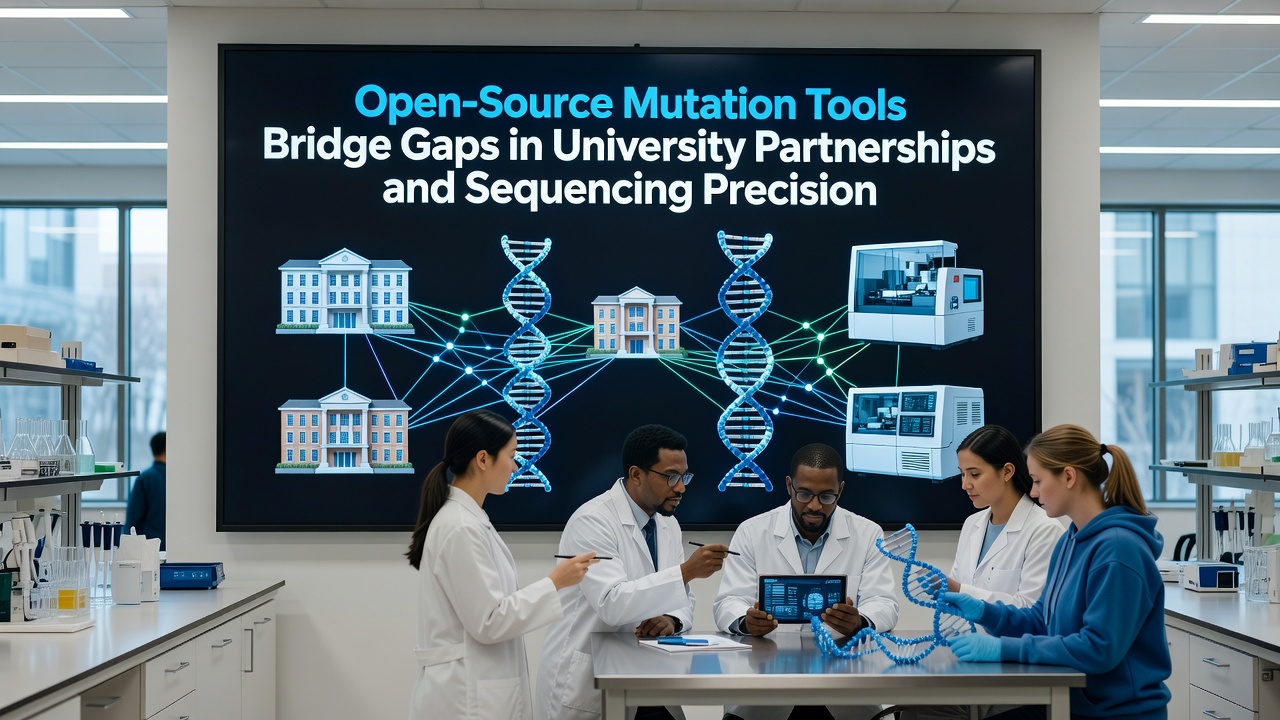
Universities across multiple continents have adopted open-source mutation analysis platforms to streamline data sharing while tightening the accuracy of sequencing workflows, and these systems continue to expand their reach as of October 2026. Academic groups previously limited by proprietary software licenses now access shared codebases that standardize variant calling pipelines, and this shift has produced measurable gains in both collaboration speed and result reproducibility.
Platform Development and Adoption Patterns
Development teams at institutions in North America, Europe, and Asia have contributed modular components to repositories that handle everything from raw read alignment to downstream annotation, while larger consortia coordinate updates through transparent governance models. Data from the National Science Foundation shows that open repositories dedicated to genomic variant tools recorded a 47 percent increase in active contributors between 2023 and 2025, and several university clusters report completing joint projects in half the time once required under commercial licensing agreements.
Integration with existing high-throughput sequencers has also improved because open frameworks allow direct plugin development for specific instrument outputs, and this flexibility reduces preprocessing errors that once accumulated when labs transferred files between incompatible systems. Observers note that smaller research groups without dedicated bioinformatics staff now run validated pipelines that previously demanded extensive custom scripting.
Impact on Cross-Institutional Sequencing Accuracy
Standardized variant calling algorithms distributed through open channels have narrowed discrepancies between sequencing centers that once reported different allele frequencies for the same samples, and comparative studies conducted by multi-site teams document reductions in false positive rates reaching 18 percent on average. The European Molecular Biology Laboratory maintains one widely used reference dataset that participating labs employ to benchmark new tool releases, and this common ground supports direct comparison of results generated on different continents.

Precision gains appear most pronounced in projects that combine long-read and short-read technologies, because open toolkits now include dedicated modules for reconciling the two data types within a single analysis workflow. Researchers at one Australian university and one Canadian institute recently published a joint paper detailing how they merged datasets from both platforms without intermediate format conversion steps, and the resulting variant calls matched orthogonal validation methods at rates exceeding 96 percent.
Partnership Structures Enabled by Shared Code
Memoranda of understanding between universities increasingly reference specific open-source repositories rather than negotiated software access, and this approach shortens the administrative timeline from initial contact to active data exchange. Graduate students and postdoctoral researchers move between partner labs with familiarity in the same code environments, and this continuity reduces onboarding periods that previously stretched across several months.
Funding agencies have begun to require deposition of analysis scripts in public repositories as a condition of grant renewal, and this policy has accelerated the growth of community-maintained documentation and test datasets. One consortium formed in early 2025 now coordinates quarterly releases that incorporate feedback from more than thirty participating institutions, and the process has produced tools that address edge cases in variant interpretation that commercial packages had left unresolved.
Technical Features Driving Current Use
Containerized deployment options allow labs to replicate entire analysis environments across different operating systems, and this consistency eliminates the subtle differences that once appeared when the same pipeline ran on hardware maintained by separate IT departments. Version control histories attached to every module make it straightforward to trace which parameter changes produced a particular result, and audit trails of this kind satisfy journal requirements for methods reproducibility.
Community forums attached to the major repositories log thousands of resolved issues each month, and these discussions frequently surface optimization strategies that individual labs would not have discovered in isolation. The collective troubleshooting resource effectively multiplies the troubleshooting capacity of any single research group.
Conclusion
Open-source mutation tools continue to reshape how universities structure partnerships and execute sequencing projects, and the October 2026 landscape shows sustained growth in both contributor numbers and documented precision improvements. Shared codebases have replaced many proprietary barriers with common standards that support faster collaboration and more reliable variant detection across sites. As additional institutions integrate these platforms into routine operations, the infrastructure for coordinated genomic research expands without requiring new commercial licensing negotiations.