
Freya Lang · 5 September 2026
Researchers from institutions in Poland, the Czech Republic, Austria, and Hungary have coordinated efforts to improve the accuracy of CRISPR gene editing in human cell models, and these projects target persistent issues such as off-target DNA cleavage along with incomplete editing efficiency. Data collected through collaborative protocols indicate measurable reductions in unintended genomic alterations when specific guide RNA designs undergo refinement, while the work draws on shared cell line repositories maintained across multiple laboratories. Teams based at universities in Warsaw and Prague initiated parallel experiments in early 2025 that extended into September 2026, and they documented how modified Cas9 variants combined with high-fidelity nucleases lowered error rates in edited T-cell populations. Figures from these studies reveal that off-target events dropped by approximately 40 percent compared with standard CRISPR-Cas9 applications, according to analyses published through the European Molecular Biology Laboratory network.Core Precision Barriers in Human Cell Systems
Human cells present distinct challenges for CRISPR applications because chromatin structure and DNA repair pathways vary between cell types, and Central European groups have mapped these differences using primary fibroblast lines and induced pluripotent stem cells. Observers note that delivery of editing components through lipid nanoparticles or electroporation affects both uptake consistency and subsequent viability, yet adjustments in buffer composition and pulse parameters have yielded higher survival rates without compromising edit frequency.
Studies conducted in Vienna laboratories examined base editor performance across multiple genomic loci, and results showed that cytosine and adenine base editors achieved cleaner outcomes when paired with truncated guide RNAs. Evidence from these trials points to reduced bystander editing, a common source of imprecise outcomes, while similar work in Budapest laboratories tested prime editing systems and reported improved insertion accuracy in genes linked to metabolic disorders.
Collaborative Methods and Shared Protocols
Joint workshops held under the Horizon Europe framework allowed teams to standardize assay conditions for off-target detection, and methods such as GUIDE-seq and CIRCLE-seq received validation across different sequencing platforms. Researchers exchanged cell samples to confirm reproducibility, and this cross-checking process highlighted how minor variations in culture media influenced editing outcomes in otherwise identical experiments.
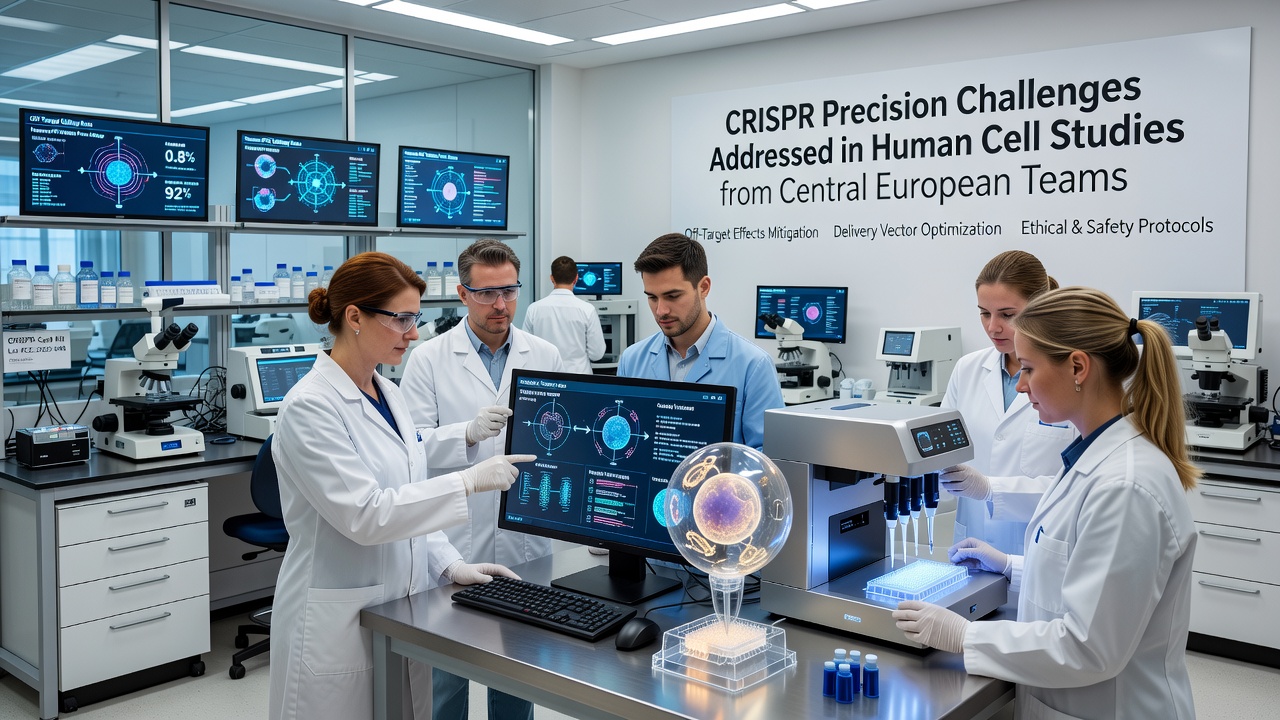
One project led by a consortium in Brno and Graz developed computational tools that predict guide RNA specificity based on local sequence context, and these algorithms underwent testing against experimental datasets generated in multiple sites. The resulting models now feed into open repositories accessible to additional European groups, and data integration from September 2026 experiments continues to refine prediction thresholds.
Outcomes Observed in Specific Cell Types
Edited hematopoietic stem cells from cord blood samples demonstrated sustained editing precision after expansion in culture, according to reports from Polish and Hungarian collaborators, while hepatocyte-like cells derived from stem cells showed comparable gains when researchers applied transient inhibition of certain DNA repair proteins. These interventions reduced the frequency of large deletions that sometimes accompany double-strand breaks.
Additional work examined CRISPR applications in neuronal progenitor cells, and findings indicated that lower incubation temperatures during editing steps preserved cell morphology without sacrificing target modification rates. Such procedural tweaks emerged from systematic screening rather than isolated discoveries, and they reflect iterative testing cycles shared among the participating laboratories.
Integration with Regulatory and Funding Structures
Projects aligned with guidelines from the European Commission Directorate-General for Research and Innovation, and this alignment ensured that ethical review processes incorporated the latest safety data from human cell studies. Parallel support from the National Institutes of Health Office of Science Policy provided reference frameworks for risk assessment that teams adapted to regional requirements.
Funding cycles that concluded in mid-2026 allocated resources for follow-up validation in three-dimensional organoid models, and these next-stage experiments aim to bridge the gap between two-dimensional cell cultures and more complex tissue architectures. Preliminary results already suggest that precision improvements observed in monolayer systems translate to organoids when delivery vectors undergo further optimization.
Conclusion
Central European research groups have compiled a growing body of evidence that targeted modifications to CRISPR components and protocols can address longstanding precision limitations in human cell studies. Continued data sharing across borders supports incremental gains that accumulate through repeated validation, and the September 2026 dataset adds concrete benchmarks for future refinement. These coordinated efforts establish reference points that other laboratories can adopt when designing subsequent human cell experiments.